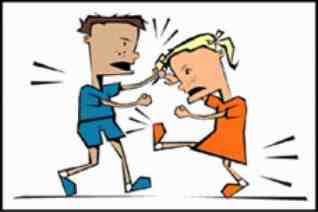
 What About the Big Stuff? – When reacting to behaviors that are harmful or threatening to a child himself, another child or children, another person, materials and equipment, or the learning process itself, you will want to use a different method because you want to eliminate the behavior on a permanent (or at least safe) level.
Try this for harmful behaviors:
Confront – Go to the child or children. Do not communicate long distance from across the room or playground. If there is a ‘victim’ of the behavior, tend to his needs first. Show empathy and concern for him, apologizing for his being hurt, physically or emotionally. Establish responsibility (as this is SO important to young children who have a strong need for “fairness). When responsibility is established, remove the perp or perps from other children so you can speak without embarrassing anyone. Turn to the child or children, get on his/their physical level, make eye contact and speak clearly and firmly in a voice that matches the message. The message is “NO. THAT WAS NOT ACCEPTABLE!” so a firm NO or YOU MAY NOT ______ is a good way to start.
Verbalize – Express yourself with empathy, not sympathy. There’s no need to ask him why he did what he did. Tell him why. Asking ‘why’ usually produces the answer, “I don’t know” or a shrug of the shoulders or a complaint about the child who has been hurt. Say, “You wanted to get the ball that went over the fence so you climbed over” or “You saw your mom’s car so you ran into the parking lot” or “You wanted to taste the scissors so you put them in your mouth”. If the behavior was harmful to another child, say, “You wanted his truck” or “You were really mad at him” or “You didn’t want her to play with your best friend”. This helps the child understand that you understand he had A REASON, BUT NOT AN EXCUSE, for his action. It gives him the opportunity to retain a bit of self-esteem.
State – Firmly state the rule or limit on behavior prefaced by the word BUT in a firm strong voice with physical stance, tone, volume, and demeanor matching the message. “BUT YOU MAY NOT climb the fence, run into the parking lot, put the scissors in your mouth, take his truck, spit on him, or call her a big fat potty head!”
Promise – State the consequence for breaking the rule and assure the consequence will occur if the behavior continues or happens again.
Teach – Offer some optional appropriate behaviors the child should have used to get the result he wanted or ask him to think of some himself. “Next time, use your words” or “What else could you have done?”
 Follow Through – Impose a negative consequence as promised if the behavior continues or recurs, and give active positive attention when behavior is appropriate. Positive and negative consequences resulting from acceptable and unacceptable behaviors build security, reinforce rules, and make a child feel safe as he knows what is expected of him.
The most meaningful consequence is the awarding or removal of your attention.
Next Blog: Some Fine Examples
 Teach 'Em the Way They Learn