 There is little that is more important than the creation of a warm, welcoming, and positive atmosphere for learning by laughing, smiling, and relaxing, and encouraging this in the children. Appropriate laughter feels good, causes the body to relax, and the brain to work more smoothly.
Humor – The use of humor as a method of creating the emotional environment of safety is important because appropriate laughter makes learning occur more quickly and with higher quality than rote memory methods of learning in an atmosphere of pressure and boredom. Development of a sense of humor is an important cognitive strength expectation. The understanding, appreciation, and creation of humor is a builder of intelligence, so teaching with and modelling humor assist in accomplishing the mission of the curriculum. Human beings with good appropriate senses of humor are more intelligent, well-rounded, and successful.
Read the works of Dr. Paul McGhee, author of many books on humor and its place in learning in children and adults. (Google him for giggles). He said, “Humor first appears when children acquire a solid enough understanding of basic features of their world to know that distortions or incongruous presentations of those features are “wrong” or, in older preschoolers, “impossible.” Believe the words of Ameila J. Kline, in Children’s Humor: A Cognitive-Developmental Perspective. L. Katz (Ed.), Current Topics in Early Childhood Education, Vol. VII who said:
“Humor is a form of play and is a natural medium through which young children can expand their understanding of the world.
Humor is highly pleasurable and is associated with cognitive mastery.
Humor provides children with problems to solve. In a joke, riddle, funny story, or cartoon, children must resolve incongruity in order to establish the joke.
Humor promotes divergent thinking, a characteristic of creativity; in order to establish a joking relationship, the child must discover or create unique associations among ideas.
Humor provides the child with an opportunity to learn rules. Humor has a basic structure that children discover when “playing jokes” on others (humor based on the element of surprise) or telling riddles (a punch line logically related to the body of the joke).”
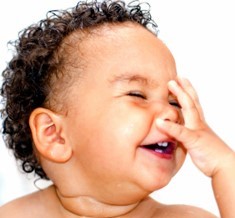 Giggles is Good – Funny things happen in the community of little learners. Children say and do things every day that make us laugh. The ‘trick’ on humor and laughter is to make sure the fun is good-natured and positive and is never aimed at humiliating a child or disrespecting his family.
Some things that I have seen even in the best of programs that are NOT funny, are:
Teasing, imitating children’s speech patterns or accents, overstimulation by physical tickling, unkind nicknames, talking aloud about a child’s appearance, clothes, food choices, table manners, hygiene, family situation, abilities, and mistakes.
If your children are not laughing and smiling during their time with you and if you are not appropriately laughing and smiling during your time with them, then take a close look at the environment you have created – the stage you have set – and make the changes needed to create emotional safety for every child through warmth and humor.
“What we learn with pleasure, we never forget.” Alfred Mercier
Next Blog: Acceptance
 Teach 'Em the Way They Learn