To Create Emotional Safety with Acceptance and Respect, We Must:
- Understand developmental nature and ‘typical’ behaviors so that a child’s actions are also understood and accepted as natural rather than “bad”
- Have realistic expectations so you don’t overtly express disappointment or compare child to child when a difference in development occurs
- Accept each child for who he is right here and now, and not what you wish or think he “should be” or “should be doing by now”
- Place no conditions on acceptance of each and every child, no matter who he is, what he does, what he looks like, or what and how he speaks
- Show disapproval of unsafe behaviors, but never of a child himself. It’s, “NO BITE”,
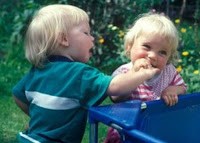 not, “BAD BOY!”
 - Allow freedom of expression, and the freedom to make errors without reprimand, critique, or judgment. All humans learn by making and correcting mistakes.
- Accept a child’s answers, attempts, and successes without judgment or immediate correction – “Almost. Good try. Think again. You did it!”
- Respect each child’s decisions and choices unless they are harmful – even if he chooses only to play with the blocks every day every day for six weeks. (Change the blocks, not the kid.)
- Practice active listening with each child every day by getting down on his physical level and making eye contact, giving undivided attention when a child speaks or attempts to communicate, restating what the child says, asking questions, and creating a personal learning connection.
 Behaviorism – The Hidden Prejudice
It is extremely rare that good teachers are openly bigoted or racist, but even in classrooms led by great teachers, who are human beings effected by stress, fatigue, frustration, and their desire to keep their community of learners safe and the learning process successful, there is a form of discrimination I call “Behaviorism”. It is the prejudice teachers have for children who exhibit inappropriate, annoying, and sometimes harmful behaviors on a regular basis or children about whom a teacher might have preconceived ideas and feelings about based on past experience with the child or members of his family.
Be honest – there is always a child (or two or three) in the community who exhibit very unattractive behaviors on a daily basis – the child whom a teacher secretly wishes might catch a mild case of the sniffles once in a while, but who has a perfect attendance record – the child whose name immediately comes to mind when there is a loud crash of noise or a cry from another student – the child whose parent is difficult to deal with – the child whose sibling was a difficult student in the past.
Without realizing it, teachers may express a bias against a misbehaving child as if the behaviors were as integral a part of the child’s identity as his race, gender, faith, or family rather than judging the behaviors as indicators of either normal developmental stages or symptoms of need for attention or correction. Teachers may even unwittingly express their behaviorism in terms and actions that are just as damaging to the child’s self-esteem as are racial or religious biases.
Some of the more subtle self-esteem crushers teachers might use are facial expressions, eye rolling, frowning, grimacing, and body postures such as turning away from a child, hands on hips, arms folded across the chest that say to the child, “AGH! You again! What is WRONG with you? Why can’t you behave?” Children are not stupid. They feel this rejection from the earliest ages and their sensitivity and vulnerability to emotional damage is intense and must be taken into consideration at every turn.
Some less obvious expressions of behaviorism are automatically calling a child’s name in a harsh manner, blaming him for causing incidents before investigating the facts, constantly “over watching” him to make sure he is not misbehaving, and sharing negative feelings about him in unprofessional ways with colleagues.
Some actions even effect educational methods a teacher may use, like ignoring a child’s needs, comments, questions, and attempts at learning; constantly harping on him, pressuring him or over correcting him; and having unrealistic expectations – either too high or too low – for the child’s skill attainment based on his behavior rather than his actual, factual intelligence or fitness.
To reduce behaviorism in your community of learners:
- Know what behaviors are natural and normal stages of development and which ones are a shout out for attention or symptoms of a serious need
- Use a developmentally appropriate behavior management system that will reduce truly harmful behaviors
- Learn to relax about behaviors that are merely unattractive and silly
- Never label a child by his behaviors
- Never let a child feel you are giving up on him, even if his behaviors are very difficult
- Understand that reluctance to fully and immediately embrace differences is human, but agree that discrimination and prejudice are simply wrong
- Be aware of any personal negative feelings and actions you may unwittingly express
- Create an environment of emotional safety for each and every child and create a community of earners for all of them
- Remember that zero tolerance is for the behavior the child exhibits, not for the child himself
Next Blog: Protection of Rights – Choice and SARA (SARA???)
 Teach 'Em the Way They Learn