The creation of Educational Safety depends on careful physical organization of the learning environment that is determined by the use of space, quality and variety of materials and equipment, and the number of children in the learning community.
I talk about the elements of choice and arrangement of furniture, equipment and materials in a preschool classroom in terms of safety, space, spaces, and stuff.
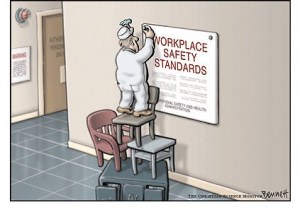 Safety – Obviously everything in a learning community for young children must be chosen and arranged with the purpose of keeping the children safe. It’s just common sense that the furniture and equipment purchased, donated, or available must be developmentally appropriate for the level of the community. This may be harder for home day care centers than public, privately owned businesses, and government or faith-based schools, but basic safety is the first and most important element in design. Sometimes overlooked items are splinters in tables, use of folding chairs, tippable shelves, peeling paint, sharp corners, and toy parts that may choke.
As for the arrangement of furniture, look at the community from the point of view of the children who will be in it. Get down on the floor and see what they will see and want to lick, bite, eat or climb on and see what they may not see and bump into. For both choice of materials and equipment and its arrangement, keep in mind what you know about the developmental behaviors of each age level. (Babies put everything in their mouths, Toddlers may run away, Twos may throw stuff, Threes are clumsy, Fours have horizontal vision – they see the horizon before what is immediately in front of them and their energy level moves them toward it – and Fives may enjoy taking things apart to see how they are made or work).
I used the word, ‘obviously’, but I have seen some incredible preventable accidents involving equipment, materials, and design – Fat little baby thighs pinched in high chairs, a teacher’s aide cooking soup in a crock pot on a shelf above an Infant’s crib, tiny Lego blocks instead of less edible-size Duplo blocks for Toddlers, a teacher using spray paint in a closed classroom full of Twos, Threes climbing up the front of unanchored shelves, storage of cleaning solutions on bathroom floors, giving a five-year-old an Exacto knife for making Valentines, and many, many, hanging, reachable, or visible extension cords being used to plug in electrical appliances.
Keeping the children alive is our basic mission. Safety is the number one priority.
Space and Spaces – It sometimes seems that there is never enough space in a preschool classroom – and if there is space, it seems as if administrators always want to sneak more little bodies into it. Generally speaking, you need to have 35 square feet of indoor space per child. Find the area (measure width by length) count your children, and figure it out. That’s your space.
There are definite functional spaces that you need to make space for in your community. For Infants (birth – 6 mos.), Babies (7 – 12 mos.), and Toddlers (12 – 24 mos.) these spaces are Eating/Feeding, Sleeping, Hygiene, Personal Storage, and Play, with Play including indoor and outdoor spaces and enlarged as the children grow in size and mobility.
For Twos through Fives, the spaces change to Eating, Hygiene in the form of a bathroom with toilet and sink, Personal Storage that is accessible to the children, and Play including outdoor spaces, of course, and indoor areas made up of space for Whole Group activities, Small Group activities, and a Safe Space that is NOT a ‘naughty spot’ for misbehaving learners, but a private space for a child needing rest, respite, or relaxation.
Note: Not talking about Learning Centers here, but classroom spaces.
Next Blog: Setting 2 – Stuff
 Teach 'Em the Way They Learn