Getting from Here to There – Transitions are the times between experiences and they must be as brief as possible. A transition may be stopping one experience to move to the next or might involve moving the community of learners to a different location. Everybody has a job in transitioning well. Teachers need to see that transitions are timed carefully with regard to developmental levels, are carried out smoothly, and that individual children who have trouble with transitioning are assisted. Administrators need to assure that schedules are appropriate for all classes. Children need to learn to stretch attention spans, build their skills in listening, direction-following and waiting, and try to adapt to transitions.
If a transition is a whole-class process like stopping Center Time to clean up and go to the playground, make efforts to do this in safe but developmentally appropriate way.
- Infants and Babies move in strollers
- Toddlers and Twos move in slow, wandering processions, stopping on their way to step in puddles, smell flowers, and experience the process of moving
- Threes will follow beautifully if they can sing or role play on their way
- Fours and Fives need to try to learn to walk in what we sometimes call “Kindergarten Lines”, single file, quiet voices, moving with a purpose
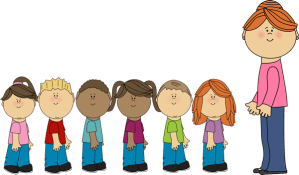
Head ‘Em Up and Move ‘Em Out – There are many ways to do this without having your class goose-step like North Korean Army soldiers on their way to a forced Kim Jong Un parade. Before you leave the room, use a fun and meaningful way to line up. For younger children, an audible signal (bell, hand clap, song) is helpful. One of the best tools a teacher can use is to dramatically look at the clock and say, “Oh, Look! The clock says it is time for (Clean up, Playground, Lunch, Whatever)! Let’s get ready to go!” This does two things – begins to help children to connect the clock with time; and puts the blame for the transition on an inanimate object, and not the mean old teacher.
Line Ups – Use your creativity and reinforce some learning. Ask them to line up by color of hair or clothing, by height, by first letter of name, by word that rhymes with name, by who played with blocks, or dolls, or paint that morning, by whose favorite pie is boysenberry (and they will laugh and say, “Boysenberry?!?”) by who has a new baby or lost a tooth, or any number of things.
 Herbie Blockbuilder – Herbie is a kid who never leaves the Construction Center. There is always – ALWAYS – a child who refuses to make or seriously cannot make a transition from one activity to another easily. Know who your Herbie is and immunize by giving him warnings that he has 5, 4, 3, 2, and then 1 minute to move. Tell him if he can’t or won’t move, you will be glad to help him (taking his hand and moving him along) or he may do it himself. Give him a job!!! “We cannot go to the playground without our Line Leader, Door Person, Light Checker, etc”
Running Rosie – Likewise there are always one or two children who find it hard to walk and stay safely with the group. Immunize again by telling the whole group (don’t single her out) that “We are going to Chapel Service now and WE ARE GOING TO WALK. If you cannot walk, I will hold your hand to keep you safe.” Then as soon as Rosie rushes off, you grab her hand firmly and walk with her. No need for lectures or ‘I told you so’s’ along the way. Have a distracting convo about the flowers, the ants, and the puddles you might see, or how much fun it was to see her pretend to be a firefighter today in the Dress Up Center.
Next Blog: Keeping it Clean
 Teach 'Em the Way They Learn