 Decision Time – The final step in the Circle Time process is Selection, which means giving each child a chance to make a decision about his plan for work – where he wants to start, or what Center he wants to work in, or what materials he wants to manipulate, or what experience he want to encounter.
Why? – Decision-making is one of THE most important skills a child needs to use, so do everything you can to make your community of learners a community of decision-making, choosing, picking out, discerning between, and selecting. Selection creates ownership – ownership creates responsibility – responsibility creates intelligence, and all of them develop a WHOLE CHILD.
How? – Before offering opportunities for selection, the teacher should tell the children what experiences are available in the Centers, and naturally, all options must be appropriate. Because of the brevity of attention span (and hopefully the interest and curiosity sparked by Circle Time) it is best if the children are given an immediate opportunity to begin working in the staged Learning Centers. (This work is traditionally called Center Time, Centers, Choice Time, or Free Choice Time).
There should be an organized system for Center Time, based on your children’s needs and developmental levels, and safety, space, and scheduling. More about this later.
Developmentally Speaking – Toddlers and some Twos may need to choose by pointing. Older Twos and Threes should be able to verbalize their selection and Fours and Fives should be more firmly asked for selections to be verbalized. A good idea I stole from Dr. Melissa Neal, University of Cincinnati, is to ask children who can print their names to sign a waiting list for a particular Center or activity. This is an outstanding method of increasing literacy and math skills in the Pre-K class. The children sign up, check the list and know when to say “I’m next!”
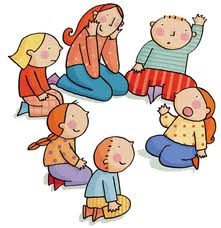
Head ‘Em Up, Move ‘Em Out – Asking each child for his selection or plan for work does not have to be a time-consuming effort. A quick turn around the circle will do it. If a child has trouble choosing or can’t verbalize his choice, skip him politely saying, “Think a little more and I’ll come back to you.”
Some teachers use a ‘ticket’ system – giving out four tickets per Center; some let the assigned Line Leader choose first; some go by the alphabet or colors of clothing or names that rhyme with _______. PLEASE do not use the old, “Let me see who’s sitting up nice and straight, cross-cross applesauce and listened best during Circle Time” system. This one is not fair to the wigglers who will never get to go first.
One of the best (quick and efficient, but totally individualized) ways to offer each child the chance to make a work/play selection I’ve seen was done by Sharon Poteat, one of my all-time favorite teachers who ended Circle Time with a clapping cheer/chant, pointing to each child in turn with, “Thomas, Thomas, what do you say? Where are YOU going to work today?” The active nature and the use of this quick-tempo chant sped up the selection process and made a great transition between Circle and Center Time.
Next Blog: Circle Time 6 – Examples of Good Circle Times
 The Perfect Storm
 Full & Fast
 And Then
 weather and “teaching” the calendar, but
 larger than you, swooped down on you in the middle of watching “Dancing With the Stars”, and dragged you into the bathroom for an underwear switcheroo? Be kind and respectful.
 Herbie Blockbuilder
 Arrival and Dismissal
 I openly admit to having been called the “Safety Witch” (or something very close to that) by some parents in my days as a preschool director, as I FIRMLY reinforced my car circle and parking lot rule to them and I would proudly accept that title again if it meant the children in my care were safely ushered into and out of school.
 Teach 'Em the Way They Learn