A Little More Collaborating

I’m Telling Mom! – Some teachers prefer collaborating with co-workers first, but talkingtelling mom to parents about these concerns should be a very close second.  Partnering with parents should be mandatory and can be done either informally or formally.  Teachers who have good relationships with parents and who have clearly and continually communicated with them from the beginning of the school term have an easier time talking to them about assessment issues. 
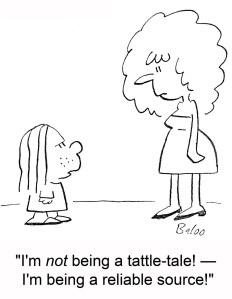
No parent deserves a surprise at mid-year or end-of-year conferences. Parents must be informed about all that involves their children – both positive and negative. When talking to parents, remember this motto: State the Strength and Note the Need! Say, “Thomas is a great listener (start with a strength). How do you feel about his speech development? (or) He doesn’t share often in Circle Time talk. (observed fact). This way, teachers and parents have a basis for a discussion of their observations and can move to the next steps in the assessment process.

Moving On Up – Collaboration with on-site or on-staff resources is limited to programs with therapists, counselors, education directors or consultants, but programs with less extensive staffs can also use senior teachers and administrators with education experience and degrees as “sounding boards” and second opinion collaborators.  Using these persons means simply moving one step closer to a professional opinion about a child’s behaviors or skills which can assist a teacher in assuring that her observations are meaningful.

Next Blog: Documentation

Collaboration

Getting Together – When you are assessing a child’s progress by finding his strengths and noting his needs, Collaboration is sometimes needed. It’s similar to a patient receiving a diagnosis from one physician and then getting a second opinion on it from another doctor. It is a teacher moving from her personal FACTUAL observation to asking another member of the learning community to either observe or recall a child’s behavior or skill performance to see if the observations match. 

The first step in Collaboration is to ask for this reinforcement without giving away your own opinions, suspicions, or concerns.  It should just be a request for her to do her own factual nonjudgmental observation. The second step is to have a meeting with her to discuss the behaviors she has seen.  This can be done with trusted co-workers, parents of the child, or on-staff advisors, consultants, or senior teachers.  It’s simply a matter of confirming a concern about a behavior or skill level before making more formal observations and moving to the steps of documentation and referral.

Team Teachers who work together well in the same classroom often become good at natural collaborating IF they share the same mission and philosophy (which we hope is ALWAYS the case) and if they communicate openly and honestly with each other.

secretsTeam Teachers or Teacher & Assistant Teacher do not have to agree on specific teaching methods. It’s always good to have some personality and preference differences – like “Good Cop, Bad Cop”, “You Do Diapers, I’ll Touch Bugs”, and the like, but they must agree on mission and DAP.


Collaboration with co-workers may be informal, but must be done in a professional manner with the utmost regard for fact and confidentiality.  You should not preface or color the request for a second opinion with your personal opinion.  If you think a child may have a speech delay or speech problem, you should ask another teacher or staff person who also comes into contact with the child to listen to the child speak.  You do not say, “I think Thomas has a lisp.  Listen to him talk,” but “Listen to Thomas and tell me what you hear.”

Tattletale, Tattletale! – The idea of confidentiality is BIG, BIG, BIG. You must keep your observations factual and your opinions about those observations in confidence. I know some children’s behaviors are the talk of the playground. Been there, heard that. To share information about a child’s needs outside of those directly associated with meeting those needs is both unprofessional and unkind.

Not only do too many cooks spoil the broth, too many opinions really stink up the preschool. You’ll have teachers in other classrooms offering opinions like, “Oh yes. I had Thomas’s sister last year and she had the same problem”, and “Thomas’s mother is a doctor. You’d think she’d get him speech therapy”, and “He’s my sister-in-law’s cousin’s boy. I’ll tell his daddy at the next reunion.” Be professional. Be confidential. Do what’s right.

Next Blog: A Little More Collaborating


Fact-Finding vs. Fault-Finding

Remember – You are assessing the CHILD’S PROGRESS, NOT THE CHILD HIMSELF!

As a Matter of Fact Observation must be done with the philosophy of FACT-FINDING, NOT FAULT-FINDING.  An observation is a statement of fact without color, judgment, personal feeling, or personal experience.  An observation states what a child does, not what a teacher thinks or feels about what he does.  Teachers must never make judgments about a child’s strengths or needs based on anything but facts, and must angel 2devilnever diagnose a child’s needs. 


Judgmental Observation and Factual Observation

  • Kurt doesn’t roll over like the other babies       Kurt does not roll over
  • Anne still sucks her thumb                                     Anne sucks her thumb            
  • John should be out of diapers by now                  John wears diapers
  • Melissa bites all the time                                        Melissa bit a child today (date)
  • Sam needs to get rid of that blankie                     Sam holds his blanket 5 hours
  • Karen is just like her sister                                     Karen chooses blocks each day
  • Bodie is shy*                                                               Bodie does not talk at Circle Time 
  • Thomas is sneaky, manipulative, steals*         Thomas takes school toys home
  • Robert may have ADD                                              Robert’s attn. span is 30 seconds   
  • Margaret needs eyeglasses                                      Margaret squints when she reads
  • Fred is not ready for kindergarten                       Fred cries 30 min. every morning

*Negative terms like this are detrimental, labeling, unprofessional, and not helpful in factual assessments of skills!  DON’T DO THIS TO YOUR KIDS!!!

Take Another Look – If teachers carefully and continuously observe their children there is less need for a formal assessment situation to occur.  When they are actively working WITH the children on a daily basis, making observations becomes more natural and comfortable.

Next Blog: Collaboration

Child Progress Assessment – OCDRP

I like an assessment method I call the OCDRP system.  OCDRP (which can be remembered by saying, ‘Our Children’s Developmental Record Process’ or ‘Ockdrip’) actually stands for each of the steps in assessment:  Observation, Collaboration, Documentation, Referral, and Planning.

It Goes Like This – The information teachers assemble through Observation and Collaboration is Documented on a form that should be devised directly from a program’s educational objectives for each age group. If a child is found to be a fragile learner or have special rights that teachers need help in planning for, a Referral should be made to a resource that can assist the parent and teacher in making a diagnosis of need and meeting the needs of this child. The form is then shared with parents at parent-teacher conferences used for sharing and Planning.  Every child is assigned a Strength Plan, developed and agreed on by both teacher and parent. 

Programs may use any professional or commercial curriculum and assessment system they wish as long as the assessment forms match the educational objectives precisely.

Step One: Observation – To observe children correctly, teachers must be fully aware of child development stages and what is considered standard behavior and skill acquisition for each stage.  Teachers must not make comparisons of one child to others, but must factually compare each child’s individual behaviors and skill acquisition to the program’s strengths or benchmarks.                                                                        

Teachers should look for:curious george

  • Deviations from the standard  – both delays and accelerations                           
  • Strengths that can be used to meet needs or build “weaknesses”                            
  • Strengths than can allow and encourage progress to continue                                      
  • Great differences in skill levels among the domains of Body, Mind, and Spirit   

Teachers should make informal observations during all elements of the day and may make more formal observations (looking at a particular area of concern in an individual child) at any time or in a “set up” assessment situation

Some issues that may cause teachers to make second or more formal observations:         

  • Obvious or suspected signs of abuse or neglect                                                      
  • Obvious or suspected health symptom (hearing, vision, motor, speech, stamina, nutrition)      
  • Obvious or suspected physical symptom                                                                 
  • Obvious or suspected delay or difference in emotional skills                                     
  • Obvious or suspected delay or acceleration in intelligence skills                               
  • Large discrepancies between developmental areas i.e. high intelligence/delayed social)
  • Difficulties noticed at specific times of day or with specific activities (transitions, meals, toileting, arrival and separation from parent)                                                           
  • At the request of a parent or when a co-worker asks for collaboration

Next Blog: Fact-Finding vs. Fault-Finding


Evaluation – Assessment of Child Progress

checkAssessment is the practice of measuring both child progress and program quality.

Child Progress Assessment is the very necessary measuring of each individual child’s progress toward attaining the program’s educational goals and the determination of any need a child may have in that progress. As we move into a time of accountability and increase testing in our pubic school system, we (early educators) must be able to prove we are offering purposeful experiences resulting in high quality BUT DEVELOPMENTALLY APPROPRIATE learning.  

Child Progress Assessment helps teachers find if there are significant delays or accelerations in development of individual children; helps them plan new learning experiences to be used for further progress, helps them to determine if they need to alter methods, materials, or environment for a particular child; and helps them decide whether or not outside assistance is necessary.

It gives parents a clear understanding of their children’s strengths and needs and can be used to track progress for each child as he moves through the stages of a single term of attendance, all through his years attending a single program, or on his educational journey to other programs and schools. 

Good teachers understand child development, know the children in their care, and both understand and agree with the expectations of the program’s curriculum.  With this knowledge they can proceed through an assessment system of their choosing to create factual and accurate pictures of each child’s progress. 

My philosophy on Child Progress Assessment is that there is a need to discover the child’s strengths and needs so the strengths can be used to continue progress, to improve areas of need, and to be used by teacher and parent to devise a written plan for that progress.

Emphasizing and using strength to meet need is the essence of positive assessment. 

Child Progress Assessment is not just an assigning of grades or number rankings, but answering the questions, “where is this child?” and “where does he go from here?

Next Blog: The OCDRP System


DAP for the Spirit – Humanity

targetYoung children are naturally self-centered (not selfish – but self-centered) because this is the way we develop as humans. We grow and develop in the pattern of an archery target, with knowledge and concern for ourselves in the bullseye and that of others in the ever-widening areas.

When I say Humanity, I mean the art of gaining the social skills that move a child from the ‘self’ to the ever-widening circles of ‘others’. 

These skills are bonding, playing, acceptance, reading social cues, empathy, respect, turn-taking, making friends, cooperating, caring for others, and caring for the environment, and these skills are ENORMOUSLY important to growth as a Whole Person and they are not always easy to attain.

 To build the skills of Humanity using DAP, try to:

  • Treat each and every child with warmth and care in a positive nurturing manner.
  • Make bonding connections with each child by saying the child’s name in an affectionate, loving, and respectful manner as often as possible.
  • Meet the needs of each child in terms of safety, security, protection, good health, good nutrition, and the use of Developmentally Appropriate Practice in educational, social, and emotional environmental facilitation.
  • Offer daily experiences during which children may work, talk, share ideas and feelings, and interact with each other and the adults in whole group, small group, partner, and individual play. 
  • Assure that one-third of the day is spent in child-chosen, child-led but adult-facilitated play experiences in which the adults play with the children on the physical level of the children.
  • Understand that young children do not grasp the concept of sharing, but can be guided to take turns.
  • Have more than one of the same toys for Babies and Toddlers, set up a timer for Twos and Threes, and ask Fours and Fives to use the clock to determine when to relinquish the toy to the other child.  This is REAL mastery of the skill of sharing or turn taking. 

The most vital teaching methods in this area are adult modeling of respectful, cooperative, empathetic behaviors and the creation of an affective environment that is safe, warm, and nurturing. So:

  • Model the characteristics of empathy, respect, cooperation, and friendship in all communication and attitudes.
  • Use, offer, and appropriately praise empathy, respect, cooperation, and friendship.
  • Help children positively interact by keeping each child safe from harm physically and emotionally; by giving them the language needed to communicate and interact; by understanding that at some stages of development, social interaction is difficult; and by helping them understand how positive attitudes and behaviors increase opportunities for making friends.
     

EQ and IQ – A child who has a high EQ (Emotional Quotient) is one who can bond and play with others, learn to take turns, accept (neither shun nor be afraid of) others, empathize with the feelings or misfortunes of others, respect differences, work and play cooperatively most of the time, and make friends. This is a child well on his way to success in life. 

“I know there is strength in the differences between us. I know there is comfort, where we overlap.”
― Ani DiFranco

Next Blog: Evaluation – Child Progress Assessment, an Overview

DAP for the Spirit – Family

Other than Self-Awareness (being able to separate, having knowledge of himself, feeling good about himself, learning to regulate his behavior, and developing a sense of humor) and Expression, the next biggest influence on a child’s building skills of the Spirit is his relationship with his Family. The triad partnership of child-parent-teacher is vital in the journey to educational success

Some suggestions for creating and maintaining this partnership using DAP are to:

  • Make positive connections with each child’s family members by meeting family, making home visits or inviting families to school before program term begins or very close to program term beginning.
  • Assure that families feel welcome to visit the classrooms at any time; that families are partners in every aspect of program curriculum from service on boards and committees, service as volunteers in classroom activities, or service as at-home volunteers; that every parent or guardian is treated as a partner in the learning process by informing them of program or classroom activity, issue, or concern; by the sharing of individual child information on learning progress or need; by offering each parent the opportunity to take part in child assessment procedures from observation through goal setting; that every family is represented in classroom display through photos or dictated family stories.
  • Completely assure that every family is treated with the utmost respect and equality in matters of behavior, ethnicity, history, gender, or ability.
  • Create learning experiences, including a weekly Home Connection, that call for family participation.
  • Incorporate family facts and concepts into the educational process as an integral domain of learning.
  • Offer learning experiences that give each child opportunities to feel love for his family and to proudly share information about his family’s daily life, celebrations, and history
    family 1

We ARE Family – Teachers must partner with parents in all areas of the program in order for the children to gain the skills and concepts listed in your program’s educational objectives.  The brain works best when the child feels safe, and the child feels safest when parent and teacher are working together.  So:

  • Make sure the classroom is representative of the ethnicity and culture of each child’s family. 
  • Assure that each and every child’s family is respected and treasured, no matter what the makeup of that family may be or how you may feel about that family.
  • Use family histories and events in the experiences offered so that the children will connect both intellectually and emotionally with their family facts, beliefs, and celebrations and will want to share these with the community of learners.

“Other things may change us, but we start and end with family.”                                     – Anthony Brandt

Next Blog: DAP for the Spirit – Humanity


DAP for the Spirit – Artistic Expression

Ah, Art – Understand each child’s artwork MUST be an original expression of the child’s feelings and ideas about events, facts, and situations, and MUST NOT be changed, altered, corrected, or edited by the adults.

Another HUGE pet peeve of mine is that many teachers do not know the difference between “ART”, which is an original creation by an artist, without addition, deletion, or change by any other person, and “arts and crafts” which are usually store-bought or teacher-created kits with a model included for each child to clone.

Please do not consider an arts and crafts project ART. Arts & Crafts projects are excellent for fine motor development, eye-hand coordination, and direction-following, but they are not ART.

Pages torn from coloring books are not ART. On a visit to a very expensive private preschool, the Head Mistress proudly pointed to over 100 identically colored pre-drawn pages displayed on the walls of her office like wall paper border and said, “Here is an example of our children’s ART.”

NO!!!! NOT ART!!!

art 4
THIS IS ART!

Original child-made creations that are altered by well-meaning teachers so the googly eyes on the snowmen are anatomically correct and the carrot noses are not “embarrassingly” placed in the lower snowball area ARE NOT ART!


No mama wants the teacher’s artwork displayed on her refrigerator or placed lovingly in her baby’s memory book.

There is nothing more wonderful than children being given the freedom and encouragement to express their feelings and thoughts and there is nothing more detrimental to learning than a classroom in which this freedom of expression is not given on a DAILY basis.

Never show disdain for a child’s expression or try to alter it to be ‘right’. 

Encourage children to praise their own work, their own words, and their own expressions.  Instead of saying “I like this picture”, try “Do you like it?  Then so do I”, or “Look what you made!  How did you do that?”

“Anyone who says you can’t see a thought simply doesn’t know art.”                        ~Wynetka Ann Reynolds

Next Blog: DAP for the Spirit – Family

DAP for the Spirit – Expression

loris-tiltedLoris Malguzzi, founder of the Reggio Emilia system in Italy following World War II, coined the phrase, “100 Languages of Children” to describe the many ways children have of expressing their learning. It’s a great way to think about the opportunities we must give children to organize and reinforce the facts and concepts we want them to know.

To allow, encourage, and celebrate expression in your children using DAP, do this:

  • Encourage and accept all forms of child communication in home and school language.
  • Ask open-ended questions that encourage language and listen attentively to what children say to encourage them to engage in frequent dialogue with both adults and other children.
  • Help children use language in social situations by saying the words for them, giving them the words, helping them say the words, and reminding them to use their words.
  • Listen actively to children’s language to gain insight into child’s feelings and model self-expression.
  • Offer a variety of experiences for children to strengthen and practice language skills (whole group, small group, and individual discussions, story times, sharing (show/tell) times, meal time and center time conversations.
  • Create an environment of warmth, acceptance, and relaxation so children feel the freedom and comfort to ask for help when needed and want to share family stories.
  • Equip the classroom and campus with developmentally appropriate material intended to build the strengths of role play including raw materials and objects to use for creating costumes, clothing for dress-up that can be used by children of either gender to represent persons of both genders, community helpers, animals, etc.
  • Assure children freedom to use those materials in child-directed, child-chosen play without disdain for choice of content (ex. boys can wear high heels and girls can be super heroes and fire fighters).
  • Sing, dance, chant, rhyme, and TALK every day!

Next Blog: DAP for the Spirit – Artistic Expression

DAP for the Spirit – Self-Awareness: A Sense of Humor

The development of a sense of humor is HUGE – so HUGE I don’t have space here to say how HUGE it is, but this is close:

huge


To use DAP through humor in the development of a “Whole Child”:

  • we must surround each child with warmth and laughter
  • we must teach with smiles
  • we must encourage children to learn to laugh appropriately
  • we must allow them to enjoy their day (and learn to enjoy ours)
  • we must offer them opportunities to hear, understand, and create


And as a famous man once said, “That’s all I have to say about that.”

forrest-gump-original