Circle Time 7 – Behaviors and Mistakes

mrs. beePersonal Thoughts on Circle Time – Call Circle time anything that suits your community (Morning/Afternoon Meeting, Group Time, Community Time, Team Time, Gathering, or use your community’s name –Tiger Talk or Mouse Meeting or the Bee Buzz.

Teachers, you set the stage and guide the conversation so there is continuity, common sense, and organization of thought.  You set the parameters of the expression.  Accept and respect their input, but keep it within the bounds of good taste and assist them in keeping on target.  Although it is REALLY IMPORTANT to let the children take the lead in the discussions, try to limit the far-fetchedness that young children (especially 4s) can sometimes go to

In every instance of allowing children the freedom to choose, select, or make their own decisions, the teacher must limit the choices to ONLY developmentally appropriate things.

A second Circle Time at the end of the day is a lovely way to review and reinforce the learning (Reflection) and to close the learning community’s time together with an optimistic and positive tone.  A community goodbye song or a team huddle with a hands-in-“BEES!” sends everyone home feeling good.

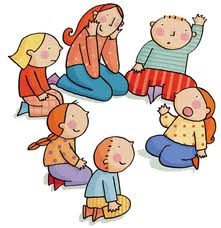
For Circle Time to Work Well – Teachers need to have an ample comfortable space for the whole group in which each child can sit comfortably and be able to see the teacher, her presentation props, and each other. 

Sitting mats with names or symbols on them or assigned seating on a rug with symbols works well, but is not mandatory.  Space and comfort are the main concerns. 

Whenever possible, both teachers should participate in Circle Time, rather than one (often the Assistant) disappearing to the office, setting up snacks, or running errands.  ALL members of the community should participate.  Props needed for Circle Time depend on the unit being introduced, but I suggest they include large chart paper or wipe-off board and markers for creating Word Walls and some type of media for the catalyst that can be seen, heard, touched, smelled, or tasted.

It does not matter how the children sit as long as they are comfortable and not encroaching on each other’s personal space without mutual approval!!!!!

Our Biggest Circle Time Errors are:

  • Dragging things out until the children have totally lost interest.  Know your ‘audience’ and know when to STOP. 
  • Taking over Circle Time ourselves and not allowing the children to talk and interact.  We are not the stars of the show, but merely the stage setters.  The children MUST be the central figures in the learning process.
  • Forcing children to sit ‘criss cross applesauce’ or ‘straight and tall’ when they must be seated comfortably; so all can see props; and so they can wiggle when they must.
  • Forcing or continuously admonishing children to “LISTEN”. If you are asking them over and over to listen, you have ‘circled’ past their attention span!
  • Starting a presentation before assuring that all children can see you as you read or show them something.           
  • Trying to get too much information into a short period of time.  You can talk more about the topic during Center Time as you move from child to child interacting with them, at the meal or snack table, on the playground, while you’re washing hands or changing diapers, and especially during any waiting times (which we hope are very brief).
  • Omitting any of the Circle Time Components:circle kids

Greeting Ritual
Relaxation Technique
Catalyst
Challenge
Brainstorm
Word Wall
Selection

Next Blog: Center Time 1 – What it is and What it Ain’t
Circle Time 6 – Samples of Circle Times

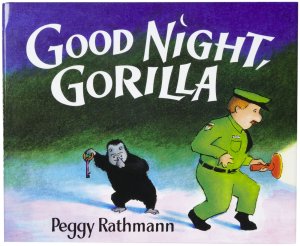
  • goodnight gorillaUnit:  Zoo Animals       
  • Greeting Ritual: “Hello Song” by Ella Jenkins
  • Relaxation Technique: “Bend and Stretch, Reach for the Stars” (Romper Room, 1958)
  • CatalystGoodnight, Gorilla by Peggy Rathmann, Word Wall materials
  • Challenge/Brainstorm/Word Wall:

Teacher:  How did the zookeeper and his wife take care of all those animals? I will write your words and ideas on the Word Wall.

Children:  There are cages!  They had keys.  The gorilla got out. I got out of my bed at night one time.  It was dark.  It was nighttime in the book.  Gorillas have hands.  I have two hands.  One time I saw the moon at night.  I would get a light to carry to feed the animals and I would lock them up.  I would hide the keys.  I would give them bananas!

Selection:

Teacher:  I’m writing your words on the Word Wall.  In the Centers are some things about the zoo.  In Blocks, there are paper tubes, popsicle sticks, and tape to make cages.  In Science, there are flashlights. In Math, there are keys and locks to match up. In Art, there are some animal stencils, play dough, and animal print material. In Role Play, there is some play fruit and pretend animals.  All over the room I have hidden some bananas.  See if you can find one with your name on it.  When I point to you, tell me where you want to work.

  • Unit: February Holidays
  • Greeting Ritual: Class Cheer – (Good Morning Tigers! Give a Roar!)
  • Relaxation Technique: Back Rubs – each in the circle child rubs a friend’s back
  • Catalyst: Box of Valentine cards and a calendar
  • Challenge/Brainstorm/Word Wall:heart wordpress

Teacher:  I just looked at this calendar and noticed that Valentine’s Day is coming next week. Here’s a box of cards I got last year. (Passes cards around for all to see). What should we do to celebrate Valentine’s Day with some people we love?

Children:  Let’s make hearts.  Let’s get red paper and streamers.  I love my grandma.  I think we need red and pink paint. A party! I can make my name on my Valentines.

Selection: Teacher:  I have your words written down.  In the Centers are all the things you need.  There’s red jello in the water table, red and pink paint and dough in Art, and you can get whatever you need from the shelves to make decorations and cards. Paper and markers are in Fine Motor for invitations and all the other Centers are open for you to work. If you want to work with Mrs. Washington on making Valentine cookies, sign up on the waiting list.

And a couple more:

Sample of Circle Time 1

Circle Time Sample Two

Next Blog: Circle Time 7 – Behaviors and Mistakes


Circle Time 5 – Ready, Steady, Go!

child decidingDecision Time – The final step in the Circle Time process is Selection, which means giving each child a chance to make a decision about his plan for work – where he wants to start, or what Center he wants to work in, or what materials he wants to manipulate, or what experience he want to encounter.

Why? – Decision-making is one of THE most important skills a child needs to use, so do everything you can to make your community of learners a community of decision-making, choosing, picking out, discerning between, and selecting. Selection creates ownership – ownership creates responsibility – responsibility creates intelligence, and all of them develop a WHOLE CHILD.

How? – Before offering opportunities for selection, the teacher should tell the children what experiences are available in the Centers, and naturally, all options must be appropriate. Because of the brevity of attention span (and hopefully the interest and curiosity sparked by Circle Time) it is best if the children are given an immediate opportunity to begin working in the staged Learning Centers. (This work is traditionally called Center Time, Centers, Choice Time, or Free Choice Time). 

There should be an organized system for Center Time, based on your children’s needs and developmental levels, and safety, space, and scheduling. More about this later.

Developmentally Speaking – Toddlers and some Twos may need to choose by pointing. Older Twos and Threes should be able to verbalize their selection and Fours and Fives should be more firmly asked for selections to be verbalized. A good idea I stole from Dr. Melissa Neal, University of Cincinnati, is to ask children who can print their names to sign a waiting list for a particular Center or activity. This is an outstanding method of increasing literacy and math skills in the Pre-K class. The children sign up, check the list and know when to say “I’m next!”

Head ‘Em Up, Move ‘Em Out – Asking each child for his selection or plan for work does not have to be a time-consuming effort. A quick turn around the circle will do it. If a child has trouble choosing or can’t verbalize his choice, skip him politely saying, “Think a little more and I’ll come back to you.”

Some teachers use a ‘ticket’ system – giving out four tickets per Center; some let the assigned Line Leader choose first; some go by the alphabet or colors of clothing or names that rhyme with _______.  PLEASE do not use the old, “Let me see who’s sitting up nice and straight, cross-cross applesauce and listened best during Circle Time” system.  This one is not fair to the wigglers who will never get to go first.

One of the best (quick and efficient, but totally individualized) ways to offer each child the chance to make a work/play selection I’ve seen was done by Sharon Poteat, one of my all-time favorite teachers who ended Circle Time with a clapping cheer/chant, pointing to each child in turn with, “Thomas, Thomas, what do you say?  Where are YOU going to work today? The active nature and the use of this quick-tempo chant sped up the selection process and made a great transition between Circle and Center Time.

Next Blog: Circle Time 6 – Examples of Good Circle Times


Circle Time 4 – Brains and Words

brainstorm 1The Perfect Storm – After using a catalyst and issuing a challenge or question, comes Brainstorming. This is giving the control of the learning over to the learners to offer ideas, words, thoughts, memories, stories, or actions to be heard, respected, commented upon, and written down.

The Biggest of the 3 R’s – Because proficiency in literacy is the basis for success in education throughout a child’s life, I strongly suggest exposing young children to as many words as possible. Books, posters, charts, menus, newspapers, and most especially, the words of the children in the class, should be posted in every area of the early education facility. Word Walls created by teacher and students at Circle Time each day are a great builder of literacy skills.

Word Walls are displays of words the children say about a unit, theme, or experience.  They are posted in the room for the children to refer to and their use greatly increases the building of vocabulary, comprehension, literacy, printing, and language skills as well as offering a great boost to self-esteem.  It is also important for preschool classrooms to have pictures and labels on furniture, equipment, and toy bins for the same purposes.

Word Walls can be made on large chart paper, construction paper, or art paper, or can be words printed on wipe-off boards and mounted on an easel or on the wall.  The main purpose is for the children to see THEIR words in print, to make and reinforce the print-to-language connection, and to feel proud ownership of their words, ideas, and opinions posted for view.

Teachers can make use of smaller word wall devices such as posting spontaneous quotes, accomplishments, milestones, play-related events, art work, and stories in the room.  Post-it notes make good tiny word walls.  Even Babies and Toddlers should have their words and works posted.  Photographs of children’s work also make excellent word wall devices.

Sample Word Walls 1

Sample Word Walls 2

WORDS, WORDS, WORDS – Sometimes the over use of Word Walls (and Word Wall devices) gets messy.  Post them for enough time for the children to get some use from them, but be aware of when the children are no longer interested in them.  There’s no need to make a new one every day.  Simply add new words to the current one and post it for a time determined by interest and use.

Post photographs of your children’s work and words.  If a group of kids make a huge intricate castle in the Construction Center with hand written pennants and banners waving from its towers, snap a picture, print it out, and post it for all to see.  Encourage the children to dictate or print a note saying, “Please Do Not Knock Down” or “Made by Mrs. B’s Bees!”

Language and Literacy skills flourish in a room full of THE CHILDREN’s words.

Administrators – here’s another area where your support for teachers is necessary.  Encourage your teachers to decorate their rooms for the children, not for the parents and licensing inspectors –as long as Word Walls are or unsafely displayed.

One of the greatest teachers I know is my friend, Sharon Poteat. “POTEAT”, as her Twos and Threes always called her, papered the walls of her room every year with the words of her children. (She also dyed her hair pink and purple to ‘teach’ colors, wore her nightie to school on Pajama Day, and defied the fire codes with her Word Wall-covered classroom). Her children loved her and when they “read” their own words to their mamas on Parent Day, there wasn’t a dry eye in the room! Word Walls Work!

Next Blog: Circle Time 5 – Ready, Set, GO!

Circle Time 3 – The Cat, COD, & COW

full and fastFull & Fast Circle Time needs to be full of child-centered activities to develop skills in Body – movement, fine motor; Mind – attention span, factual knowledge, memory, direction-following, problem-solving, listening, comprehension, and possibly math, science, and social studies; and Spirit – self-concept, self-esteem, self-regulation, using words, conversation, social cues, empathy, respect, and turn-taking – all in less than 15 minutes max!

In Reality – a good Circle Time will automatically and naturally contain all of these things and it should not be rushed, but must be carried out with attention to developmentally appropriate attention spans.

Ignition! – The best way to introduce a unit or topic of study is with a book, an activity that is ACTIVE and hands-on, or a question, problem, or challenge.  This is what I call the Catalyst, abbreviated here as the Cat. It is the spark that ignites interest in the information. The Cat may also be presented in the form of a Challenge of the Day (COD) or for older children, the Challenge of the Week (COW).

Let’s Just Swim with the COD – The COD may be related to a Strength Expectation (specific skill objective), a unit of study, the planning of an upcoming community event, or even an immediate situation or issue in the community.  It doesn’t have to be presented at Circle Time, but this does seem to be an opportune time for it.

Using a good, relevant, child-centered COD that peaks interest, encourages curiosity, and motivates children to move from thought to action (or Circle Time to Center Time) is an example of an excellent Developmentally Appropriate Practice (DAP) and a wonderful catalyst for optimal learning.  The point of issuing a challenge is to encourage development of cognitive and expressive skills on a higher level than mere memory.  

The teacher introduces the challenge and the children brainstorm solutions.  All solutions are accepted and respected.  To use the COD, teachers need to train themselves to present facts and to ask open-ended questions.

Make the COD relevant and ‘doable’ so there is big interest but little frustration. We need to try not to answer every question a child has, but challenge him to research, experiment, and think for himself.  We need to ask questions about experiences so children learn to recall and restate; to ask why and how questions so children learn to use logic and reasoning; to ask “how else could we do it?” so children learn invention and creativity; and to ask “what do you think will happen next?” so children learn sequence and how to make sensible predictions. 

CODs are not restricted to Circle Time. Here are some CODs to try to catch:

funny fish

A Whole School of CODs

One day I subbed with a very good teacher, Miriam Gabra, who had a class of 4’s with WAY TOO MANY BOYS, and her challenge for the day was to “see if you can use your words ALL day and not your hands, feet, or elbows”. It worked. Genius.

Fish or Moo Every Day!! -The learning from CODs and COWs is ENORMOUS AND IMPORTANT.  It crosses over and interrelates into every Learning Area, every General Strength Expectation, and every Specific Strength Expectation.  Even Infants and Babies can take on nonverbal challenges (problem-solving learning experiences) such as putting ‘barriers’ of safe objects in front of them, briefly hiding toys, or requesting a verbal or sign language gesture before immediately granting a request.  As always, developmental appropriateness is the watchword.

Next blog:  Circle Time Part Four: Brainstorming, Word Walls, & Selection


Circle Time Part 2 – The Basics

Basic Circle Time Approach – Circle Time should begin with a Greeting Ritual  and a Relaxation Technique in either order or combined into a single activity.

A Greeting Ritual, like singing a good morning greeting song, reciting a cheer, chant, or affirmation, reciting a prayer or the Pledge of Allegiance together (see the previous blog on ‘calendar’ and flag waving) encourages that important sense of community, family, and teamwork that is SO necessary for educational safety and optimal learning.

Having a morning Relaxation Technique, be it prayer, deep breathing, stretching, yoga, passing hugs around the circle, or even mutual shoulder massages is a wonderful way to set a mood and allow children to prepare themselves for attentive listening and sharing of ideas. Sometimes faith-based programs get a little hinky about using relaxation techniques that are derived from philosophies they see as “threatening” to their own beliefs. To them I say, Relax!

circle time kidsAnd Then – Typically, after the community has settled and is paying attention, the theme or topic of discussion is presented using a Catalyst of some sort and the teacher opens up a Brainstorming session including the issuing of a Challenge, question, or project in which the children express ideas, thoughts, opinions, memories, facts, or simply words about the topic. 

The teacher accepts all expressions, asks open-ended questions, gives facts and language as needed, and writes down the children’s words to post as Word Walls. There may be a theme-related book, song, chant, poem, or movement activity presented before or after the theme is introduced, there may be puppets or real objects passed around for inspection, or any other brief activity relating to the theme and its key concepts. 

And Finally – Lastly, the teacher offers each child the opportunity to choose an area in which to begin to interact with the carefully orchestrated materials set out for them and each child makes a decision about his plan of action.

(This time of Purposeful Play is usually called Center Time. If possible, it is good to have Center Time immediately follow Circle Time, even for a brief period, because the children will be eager to move into the work right away and may lose interest in the topic if too much time passes between Circle and Center Times). 

Think of Circle Time as the pep talk or the huddle before the big game begins.

Next Blog: Circle Time 3 – The Cat, The COD, and The COW

Curricular Elements – Circle Time Part 1

The Curricular Elements I like to include in the day are:

  • Circle Time – a gathering for the purpose of setting a mood and introducing a unit
  • Center Time – opportunities for chosen activities in using all 6 Learning Methods*
  • Literacy Events – formal reading opportunities
  • Gross Motor Time – planned, active, physical movement opportunities
  • Music – opportunities for song, dance, chant, listening, and creation of music
  • Group Times – opportunities for individual, small, and whole group learning
  • Home Connection – an active ‘assignment” for family participation in learning

Circle Time – This is a teacher-initiated but child-centered and child-inclusive meeting which sets the mood for the day and introduces the unit of study through use of:

  • Greeting Ritual – cheer, chant, song, or affirmation to build community
  • Relaxation Technique – breathing/stretching/yoga exercise to “get the wiggles out” 
  • Catalyst – book, song, challenge, or activity that sparks interest in the day’s unit 
  • Brainstorming – a full group opportunity to share words, thoughts, ideas, memories
  • Word Wall – the recording of the words, thoughts, ideas, and memories
  • Selection – an opportunity for each child to select where and how to begin to work

Circle Time may be held at any point in the day, but seems most appropriate early in the day as it sets the mood and introduces the choices available for interaction.  If all children arrive at once, this is a good way to begin the day.  If the children arrive individually at varying times, it is better to have quiet child-chosen activities available until all have arrived, and then begin Circle.  A Dismissal Circle for sending the community of learners home with warmth and positivity, offering a time for Reflection, and a reminder about the Home Connection may also be held. Some programs call Circle Time, Morning (or Afternoon) Meeting or the Gathering.

Circle Time is not normally used with the Infant community, but can be done in a VERY informal way for Babies, a more formal way for Toddlers, and should be handled formally but developmentally for all older learners. Circle must last only for a developmentally appropriate time but must include both active and quiet activities, both teacher-led and child-involved activities, and a time of whole group work and individual input.

NO FLAG POKING!Many teachers insist on a daily Circle Time ritual of checking thekid with flag weather and “teaching” the calendar, but this is not vital and the methods used to review calendar skills MUST be developmentally appropriate. Circle Time is used to set a mood of eagerness to learn, to introduce the work of the day with excitement and wonder, and to encourage self-expression and develop skills in all areas. I really, really dislike that daily repetitive system of “learning the calendar”.  It takes up way too much time that could be spent on allowing the children to talk, sing, dance, and actively involve themselves in learning.  By the time you have asked, “What day is it? What was yesterday? What is tomorrow?  What month is it?  What year is it?” and they all scream in unison (with half of them getting it wrong) “FRIDAY!!!,” and then choose a flag holder who pokes his friends in the eye as he waves the flag and you all sing a patriotic song or recite the Pledge, they are already beginning to veg out and be tired of Circle Time and you still haven’t gotten to any useful learning. 

So, if you feel you MUST “teach” the calendar (which, by the way does not make sense to the brain until that brain is seven years old, no matter what your curriculum goals say) be creative in getting this information into your children’s heads in other ways.  How about saying, “Good morning, Bees.  Look at the calendar.  Yesterday was Sunday.  I went to church.  What did you do?” Get THEIR personal stories or just let them call out what they did and say, “Today is Monday.  MMMMMonday starts with letter M.  I’m writing that on our word wall.  Let’s sing the days of the week song in a funny voice”.  Everybody sings and giggles and then you start to introduce the work of the day or move to repeating the Pledge (with a poker-free flag) singing a good morning song, or reciting a mood setting prayer.

Check out these alternative calendar teaching techniques: 


Next Blog: Circle Time Part 2 – How to Do a Circle Time

Routine Elements – Rest Time and Naps

Naps – Programs may or may not include napping in their schedules. The purpose of napping is obvious – to allow any child who is tired, to rest and rebuild his stamina. All programs must follow licensing and health regulations concerning type, placement, and sanitation of cribs, cots, or rest mats.

Speaking (and Sleeping) Developmentally – Sleep is a must for Infants and Babies and must be offered according to each child’s needs.  Sleep may be optional for Toddlers and Twos and is dependent on the number of hours of attendance. Many Toddlers and Twos can stay awake for up to four hours of attendance without a nap, but programs must have a place for them to rest if there is a need. some Threes, and most Fours, and Fives can stay awake and alert for a full day of preschool, including an after-hours or extended day program of up to two hours, but any child who shows signs of fatigue must be allowed to rest, nap, or, when optional, go home to rest.sleeping baby

Zzzzzzz – Remember that there are many symptoms of fatigue, including inappropriate behaviors like whining, fussing, and aggression, and that fatigue can also be a symptom of illness. It is the teacher’s responsibility to carefully observe each child for signs of fatigue, to make sure there is a space in the classroom (or in the Infant or Baby classroom, the teacher’s workroom, or the administrator’s office) for a sleepy child to rest.

Safe Spaces – Each class must have a Safe Space – the place where tired, out-of-sorts, coming-down-with-something-but-not-sick-enough-yet-to-go-home children may cuddle up and hunker down with soft toys, books, or even an e-tablet (!) and remove himself from the chaos of the classroom. THIS IS NOT A PUNISHMENT PLACE OR A TIME OUT AREA OR A NAUGHTY SPOT!!  It is a quiet comfortable space for rest and relaxation.

You Can Lead a Horse to Water, but YOU CANNOT FORCE A NAP! – Children may be gently, matter-of-factly, or firmly asked to lie down. They may listen to music, read a book, have a back rub, or be taught to deep breathe and meditate, but you cannot force a human being to sleep. Understand your child development, get to know your children and their individual signs of fatigue, and relax about napping.

Next Blog: Curricular Elements – Circle Time


Routine Elements – Keeping it Clean

Cleanup Time – The purposes of Cleanup Time are to reorganize the environment after use, encourage the building of the Body skills of fine motor, the Mind skills of intelligence, literacy, and math, and the Spirit skills of caring for the environment, responsibility, and cooperation.  Cleanup Time can be done with older Babies, Toddlers, and all older children.  Teacher participation is a must, and each child should have a part to play.  Cleanup should take about five minutes (for younger communities) and may take up to 10 minutes for 4s and 5s.

kids cleaning upCleanup Time is Vital! – There are many children who are not given the responsibility of cleaning up after themselves at home. Busy parents find it much easier to just do it themselves rather than go through any histrionics involved with chores or simply putting toys away. Teachers can help with this by educating parents about the benefits of ownership and responsibility.

Give every child, or small group of children, a specific job in the process. Cleanup Captain, Block Boss, Kitchen Committee, Lego Leaders, Table Sprayer (water) and Table Wiper, and my favorite, if your program can afford a hand-held vacuum for each room – Dustbuster!

Hygiene – The purposes of scheduling times for hygiene are obvious.  Hand-washing and toileting are a natural and necessary part of daily life. Hand-washing is mandated by licensing agencies to take place at specific times during the day (after Arrival, after time on the Playground, before Meals and Snacks, and after an individual child uses the toilet).  Obviously, as children gain more skill at self-help and hygiene skills, they become more responsible for the process and its timing.

Teachers of Infants, Babies, Toddlers, and Twos need to schedule diapering times that cause the least interference within their communities.  Teachers of children in toilet training need to be flexible with schedules.  Teachers of children out of diapers can relax about structuring specific times for whole group toileting. 

Try not to just scoop up your diaper guys without giving them warning, unless there is an emergency of a fecal nature (fancy talk for BIG POOP). If possible, talk to them – even the Infants and Babies – so they build some language skills and some understanding of the need to be changed (cause and effect). Use the same techniques for whole-group diaper changes I suggested in the blog on Transitions – “the clock says it’s time to get new diapers on”, but try not to interrupt a child who is really engaged in learning simply because the clock says it’s time.

Some children are very private about changing, so I suggest teachers be empathetic with them rather than too firmly insistent. After all, how would you feel if a person muchunerwear larger than you, swooped down on you in the middle of watching “Dancing With the Stars”, and dragged you into the bathroom for an underwear switcheroo? Be kind and respectful.

NEVER force toilet training. Talk to parents about their concerns, thoughts, and methods, but forcing this particular phase of development does have possible negative consequences on some children.

Next Blog: Routine Elements – Rest Time and Naps

Routine Elements – Transitions

Getting from Here to There – Transitions are the times between experiences and they must be as brief as possible.  A transition may be stopping one experience to move to the next or might involve moving the community of learners to a different location.  Everybody has a job in transitioning well. Teachers need to see that transitions are timed carefully with regard to developmental levels, are carried out smoothly, and that individual children who have trouble with transitioning are assisted.  Administrators need to assure that schedules are appropriate for all classes.  Children need to learn to stretch attention spans, build their skills in listening, direction-following and waiting, and try to adapt to transitions.

If a transition is a whole-class process like stopping Center Time to clean up and go to the playground, make efforts to do this in safe but developmentally appropriate way. 

  • Infants and Babies move in strollers
  • Toddlers and Twos move in slow, wandering processions, stopping on their way to step in puddles, smell flowers, and experience the process of moving
  • Threes will follow beautifully if they can sing or role play on their way
  • Fours and Fives need to try to learn to walk in what we sometimes call “Kindergarten Lines”, single file, quiet voices, moving with a purposekids in a line

Head ‘Em Up and Move ‘Em Out – There are many ways to do this without having your class goose-step like North Korean Army soldiers on their way to a forced Kim Jong Un parade. Before you leave the room, use a fun and meaningful way to line up. For younger children, an audible signal (bell, hand clap, song) is helpful. One of the best tools a teacher can use is to dramatically look at the clock and say, “Oh, Look! The clock says it is time for (Clean up, Playground, Lunch, Whatever)! Let’s get ready to go!” This does two things – begins to help children to connect the clock with time; and puts the blame for the transition on an inanimate object, and not the mean old teacher.

Line Ups – Use your creativity and reinforce some learning. Ask them to line up by color of hair or clothing, by height, by first letter of name, by word that rhymes with name, by who played with blocks, or dolls, or paint that morning, by whose favorite pie is boysenberry (and they will laugh and say, “Boysenberry?!?”) by who has a new baby or lost a tooth, or any number of things.

hookHerbie Blockbuilder – Herbie is a kid who never leaves the Construction Center. There is always – ALWAYS – a child who refuses to make or seriously cannot make a transition from one activity to another easily. Know who your Herbie is and immunize by giving him warnings that he has 5, 4, 3, 2, and then 1 minute to move. Tell him if he can’t or won’t move, you will be glad to help him (taking his hand and moving him along) or he may do it himself. Give him a job!!! “We cannot go to the playground without our Line Leader, Door Person, Light Checker, etc”

Running Rosie – Likewise there are always one or two children who find it hard to walk and stay safely with the group. Immunize again by telling the whole group (don’t single her out) that “We are going to Chapel Service now and WE ARE GOING TO WALK. If you cannot walk, I will hold your hand to keep you safe.” Then as soon as Rosie rushes off, you grab her hand firmly and walk with her. No need for lectures or ‘I told you so’s’ along the way. Have a distracting convo about the flowers, the ants, and the puddles you might see, or how much fun it was to see her pretend to be a firefighter today in the Dress Up Center.

Next Blog: Keeping it Clean