DAP 1 – Dap It or Don’t Do It At All!


 DAP stands for Developmentally Appropriate Practice. It should be the essence of our work with all children, but in particular with those from birth to eight. Using DAP means doing the right thing for the right reason in the right way at the right time. Right?

Experts Say and I Believe – In “Developmentally Appropriate Practice in Early Childhood Programs” by Sue Bredekamp, Carol Copple, and the National Association for the Education of Young Children, the authors tell us that “DAP has to do with creation of an environment that includes relationships with responsive adults, active, hands-on involvement, meaningful experiences, and opportunities (for children) to construct their understanding of the world.  This is done through work in large groups, small groups, play and engagement in learning centers, and in the (normal) daily routines.  Practitioners of DAP promote the health and development of the whole child, not just the aspects measured on the standardized tests.” 

The determination of what practices are developmentally appropriate takes careful attention to, firm belief in, and continuing study of child development theory and brain/learning research; careful observation of the children in the learning community; careful and factual assessment of each child’s strengths and needs; honest and open evaluation of methods, techniques, and experiences; and the willingness to be flexible in modifying plans, experiences, and practices that do not work.

Using DAP Just Makes Sense – When you match the teaching methods to the level of the learner, you make the learning process easier for the learner and for the teacher and you raise the value of the learning experience. 

When you teach the way children learn, there is increased speed of learning, better quality of learning, better retention of learning, and the mood of the learning process is much more positive than if non-developmentally appropriate practices are used. 

When the process is positive, the learner has increased self-esteem and comfort, the learning increases and improves, and as a wonderful side effect of using DAP, behavior improves so the process becomes easier and more enjoyable for the learner and the whole community of learners.

My Take – The use of DAP throughout the learning process means:

  • Believing the Evidence on child development
  • Matching Strength Expectations to the levels of the community of learners
  • Creating/Maintaining an Environment of Safety                                    
  • Providing real and relevant Experiences for active learners                                
  • Executing Experiences in the ways that match developmental needs           
  • Factually and professionally Evaluating the progress and needs of each child

More specifically, the use of DAP means:

  • Paying VERY careful attention to limits and vulnerabilities
  • Keeping the community of learners safe at all times
  • Providing positive, warm, and supportive relationships         
  • Lessening pressure by reducing test-performance-product-style activities 
  • Providing stimulation and challenge without frustration                            
  • Making factual, judgment-free assessments and reasonable, reachable plans for progress

Next Blog: DAP 2 – Even More Specifically. . .
 

More Humanity – Environment, Child, & Community

The aspects of the Human Factor are Teacher, Environment, Child, and Community

The Emotional Environment – Each teacher must create and maintain an environment in her learning community that builds individual self-esteem and engenders an overall sense of community for the class.  This aura of positivity creates a place where the human factor can relish. The prerequisites for creating this positive emotional environment are:

  • Warmth and Humor – Positively Positive, even in Firm Discipline        
  • Acceptance and Respect – True Aretha Franklin R-E-S-P-E-C-T
  • Protection of Rights – Choice, Expression, Mistakes, and Personal & Special Rights
  • Assignment of Responsibilities – Teachers and Children Working
  • Celebration – Rites, Rituals, Customs, Milestones, and Shared Personal Stories
  • Connections with Families – The Partnership that Works

The Individual Child – Each child, as a valid, valuable, and vulnerable human being must be granted ownership of his learning.  He may not be aware that he has this responsibility for being part of the necessary human factor of the learning process unless the teacher grants it by creating and maintaining an emotionally safe environment and by knowing when to step in and when to step out of the process, when to answer questions and when to ask them, how to be patient and wait for him to take over the process, and of course, by knowing how to gauge her involvement based on her knowledge of child development. 

The child may not have a formal philosophy, but he will develop an attitude toward learning and he will take specific actions according to that attitude.  It is up to the teacher to observe his interest, curiosity, ability to participate, and his past actions and then encourage him to involve himself fully in all facets of the process.

The Learning Community – All of the children in the community, given this same ownership, must be offered opportunities for group learning.  It is said that we humans learn best (that’s our mission – optimal learning) when we teach someone else.  Shared learning is best for most humans because it provides the feedback and support that increases the quality and the efficiency of the learning.  Young children learn by imitating the actions of others, and peer “pressure” is a very strong force, so the human factor involved in learning refers to the teacher and the human and safe environment, each child as an individual, and the learning community as a whole.

Parents, treated as fully invested partners in the learning process, are a vital part of the human factor. They must be offered full membership in the community and always be included with respect and dignity. Never Forget the Parents!

And the ‘Adminnies’Directors, Principals and Support Staff must be included as part of the team in the mission of optimal learning for each child. They must be present and visible and available and must do all they can to support the teaching staff and every child.

Final Thoughts on the Human Factor – When I visit preschool and elementary classrooms these days, I am stunned – STUNNED – by the lack of the human factor in teaching. In particular in K – 2 classes, teachers are not given the time they need to interact on a personal level with each child daily, and some preschool teachers are not taking advantage of the time they do have to improve the learning and the behaviors in their learning communities by connecting to each child in a personal, respectful, and humane manner.kids off the bus

Here are some simple ways to use the human factor in your program:

  • Greet each child every morning in a sincerely welcoming voice
  • Make eye contact and smile at each child daily at some point
  • Pronounce each child’s name correctly!!!! (And spell it right, too).
  • Use Active Listening (eye contact, no distractions, respectful) to each child as he coos, blathers, stammers, repeats, shares, retells, or even seems to make little sense
  • HAVE CONVERSATIONS!!! – Talking WITH each child, not just talking to present facts, correct behavior, give directions, or give meaningless praise
  • Use gestures (smiles, winks, thumbs-ups, high fives) with eye contact when you see positive behaviors 
  • Sing (in your own croaky voice) and dance (with your over-20 year old body) with the children rather than only using a recorded professional CD
  • MAKE PERSONAL POSITIVE CONTACT WITH EACH CHILD DURING CENTER TIME!!!!

Next blog:  Execution – How the Learning is Delivered – DAP, Part One

Execution of Experiences – Human Factor

teacher and childExecution has to do with how the Learning Experiences are offered to the children or how the learning is delivered to them. The two basic (but HUGE) elements of Execution are the Human Factor and Developmentally Appropriate Practice or DAP.


Most of the best theories and virtually all research on child development and learning completed in recent time, stress the importance of the human factor in assisting children to grow and learn in the best ways.  The Gesell Institute says, “healthy development depends on the quality and reliability of a young child’s relationships with the important people in his or her life, both within and outside the family. Even the development of a child’s brain architecture depends on the establishment of these rela­tionships.  Young children experience their world as an environment of relationships, and these relationships affect virtually all aspects of their development”.   

I Do It My Way – I follow a curricular continuum that explains each step of the early learning/teaching process. It begins with Evidence – the proven facts of child development; moves to the Expectations – the educational objectives we have for each child’s learning; continues to the Environment for learning, which I contend is Physical, Emotional, and Educational Safety; describes the Experiences teachers need to offer and the Execution or delivery of those experiences; and culminates with Evaluation or assessment of each child’s learning and of a program itself.

I am reviewing the curricular continuum to stress that the Human Factor has to be present not just during child-teacher interactions, but the aspects of philosophy, attitude, and action need to be taken into account throughout the whole curricular process from Evidence to Evaluation.

The Components of the Human Factor are:

  • The Teacher, in knowledge, committment, and involvement
  • The Positive Emotional Environment of safety the teacher creates and maintains
  • The involvement and participation level of each Individual Child
  • The Learning Community, including parents, administrators, teacher, & children

Human Factor – The Teacher

Next Blog: The Human Factor 2 – The Environment, The Child, The Community

From Tees to Tails & Making SPARKS!

From Casual to Black Tie – Teachers can create Formal Experiences from Informal Experiences by observing carefully during Routine Elements of the day. This is the essence of child-centeredness in the early education curriculum. Here are some simple examples:

  • Babies on their stroller travels around the campus react to seeing a dog.  Teacher plans an experience on pets.
  • Toddlers being helped to wash their hands put the water on their faces and react to its temperature.  Teacher plans an experience on hot and cold.
  • Twos jump into a puddle on their way to the playground.  Teacher plans an experience on rain.
  • Threes enjoy pretzel sticks at snack time.  Teacher plans an experience using pretzels to make lines and letters.
  • Fours fight while in line at the bathroom.  Teacher issues a Challenge of the Day and creates a Word Wall about using words to express anger and some experiences that build self-regulation, turn-taking, and patience.
  • Fives notice the letters on the ambulance that passes by are backward.  Teacher plans a journaling assignment and an experience with mirrors to see if they can figure out what the letters spell out.

Sparks! – The Reggio Emilia curriculum developed by Loris Malaguzzi after WW II, suggests that teachers create ‘provocations” which are thought-provoking, aesthetically pleasing experiences for young children in which the teacher creates a purposeful and intentional but open-ended activity in which children work with and manipulate materials in any safe way they choose.  The teacher observes and documents, adds language or facts as needed, asks open questions, and encourages the children to use what Malaguzzi called their “hundred languages” to express what they are doing, what the materials feel like, how they may be used, what they might be made of, how they might be paired with or compared to other materials, and any other ideas and learning they may discover.

I strongly believe that ALL Formal Learning Experiences must be provocations; all must be thought-provoking, open-ended, purposeful, attractive to the children*, and intriguing to take part in; all Learning Experiences must inspire, encourage, and engender primary, secondary, and spontaneous learning.

*Lots of teachers are very into Reggio these days and I love it, BUT I have a BIG BUT. There is a tendency to make these provocations very femininely attractive from the teacher’s or parents’ point of view, with natural woven baskets, gauzy materials, tiny holiday lights, and other Pinteresty-looking things, rather than being attractive to the preferences of the children. Many of the children may not be lured into a learning experience that is stereotypically “pretty”.

Use the other Reggio device, “loose parts” and raw materials that are not stereotypically feminine in your Sparks. Throw a box of nuts and bolts in there and a basket of rocks or sticks from the playground and rolls of duct tape with potty paper tubes. Observe what does interest your children and go with things that may not look orderly and sweet, but will truly encourage participation.tires

Tires Ain’t Pretty – Long years ago there were commercials for a tire store in Orlando, using the catchphrase, “Tires Ain’t Pretty”, and they aren’t, but can you imagine the children’s interest and engagement levels if your playground or classroom had tires full of sand, building blocks, toy vehicles, math counters, pine cones, nuts, bolts, keys, locks, BOOKS and all kind of learning materials? I can.

Ignite a Fire of Learning – Make all your Learning Experiences SPARKS!

– Strong Purposeful Appropriate Real Kid Stuff

Next Blog: Execution of Experiences – The Human Factor

Informal Learning Experiences

Informal (Casual Monday – Friday) Experiences – These are the natural movements, proceedings, actions, and events that occur through participation in the Routine Elements of the Day (arrival, meals, transitions, hygiene, cleanup, and dismissal).  They are not documented, posted, or planned, but they almost automatically contain the same factors as Formal Experiences, which are:

  • Learning         Primary, Secondary, and Spontaneous
  • Components   Learning Methods, SARA, Purpose, Feedback, Accountability
  • Production      Planning, Presentation, Participation, Appraisal

Learning – Informal Experiences can produce all three types of learning. If a transition or a meal experience is used appropriately, it can produce Primary Learning in that stated learning objectives can be gained.  If Primary Learning takes place, Secondary Learning can also occur, and Informal Experiences are full of Spontaneous Learning moments of discovery and creativity.  The important factor is recognizing the learning and giving it value.

Threes lining up to go to an Enrichment Class or the Playground gain Primary Learning by building skills of listening and following directions.  If they sing as they walk, they areworm gaining Secondary Learning (unplanned by inspired and still on the “list” of learning objectives – musical expression, relaxation, vocabulary, walking to a beat).  If they discover worms on the sidewalk and stop to observe them, they will be involved in Spontaneous Learning about zoology and movement and texture – facts that were totally unplanned and new!
Components – The components of Informal Experiences are the same as those for Formal Experiences, but they occur naturally rather than being purposefully and formally planned.  For example, lining up to move the community to a different location automatically contains movement, senses, language, expression, purpose, feedback, repetition, and application.  If teachers add real objects (bring books to read in case there is a waiting time) then it becomes a perfect learning experience.

Production – Informal Experiences are not produced, as they happen naturally. But, they can certainly be made into positive, high quality learning experiences with Planning, Presentation, Participation, and Appraisal.

Planning for informal experiences means using a developmentally appropriate schedule, preparing the environment for ease and efficiency, and preparing the children by trying to create routine and repetition and by verbally reminding them before the experience occurs.

Presentation of the informal experience means creating a sense of calm and leadership so the routine parts of the day go as smoothly as possible.

Participation in informal experiences should be happening naturally. This means teachers sitting down to eat with children rather than hovering, serving (and making judgements about what, how, and when to eat). It means being an ACTIVE and PRESENT part of all that happens each day.

 Appraisal of the informal experience means observing and judging the quality and efficiency of the experience and making needed changes. If arrival time is full of tears and tantrums, it is not a positive informal learning experience.  If hand washing includes long waiting or pushing at the sink, something needs to be modified.  If a fire drill results in all children evacuated to a safe place successfully, then it was an appropriate informal learning experience of good quality.

Next Blog: From Tee Shirts to Tails – Making Formal Experiences from Informal Ones

How’d It Go? – Assessing the Experience

Appraising the Quality of Formal Experiences – The predicted value of each formal experience can be determined by asking these questions:

  • Is it designed to match specific strength expectations of the community?
  • Will its timing match the attention spans of the community?
  • Does it include opportunities for Selection, Action, & Application?
  • Does it include something a young child can Reflect on immediately or at a later time to reinforce learning?
  • Is it PROCESS, not PRODUCT oriented?
  • Will it be enjoyable?
  • Can it be successfully carried out in an atmosphere of both warmth and wonder, relaxation and stimulation, and challenge without frustration?

Before – Think about this. Will it be:          

  • Right – Does it match up with the learning objectives of my program?
  • Reasonable – Is it “doable”? Is it practical?
  • Real – Are the children going to be moving, active, and hands-on?
  • Relatable – Is it relevant to these children and their families?
  • Repeatable – Can the children practice the skills learned in it over and over?
  • Relaxing – Can it be offered in a safe, organized way?
  • Recreational – Is it going to be fun?
  • Riggable – Can it be modified easily if it doesn’t work?

And AfterWas the experience Righteous? Was there Primary, Secondary, and/or Spontaneous Learning?

PJ Day!kids in pajamas

Once I visited a program on Pajama Day. This was a program-wide event but teachers could plan for it individually, depending on the needs of their children. The teachers who understood and believed in DAP and knew how to use this learning experience in the best, most creative, and wonderful way, did this:

Made PJ Day a purposeful learning event by ‘assigning’ it these concepts and skills:

  • Intelligence – opposites: day and night, dark and light, soft and loud
  • Language-Literacy – reading Stella Luna and Good Night, Moon
  • Math – counting stars and counting sheep
  • Science – nocturnal animals and sun, moon, and stars
  • Social Studies – kinds of beds – for people and dolls and animals
  • Expression – sun and moon art, dark and light colors, black paper and gold stars, stripes and dots and pajama colors
  • Gross Motor – Pajama Parades and Tiptoe Walks
  • Spanish Enrichment – ‘dia’ y ‘noche’, ‘blanco’ y ‘negro’
  • Music Enrichment – lullabies and soft songs
  • Journal/Dictation – “Once I Had a Dream About. . .”
  • Home Connection – Take a nighttime flashlight walk with Mom and Dad!

Talked about Pajama Day at Circle Time and Home Connection on the previous day       

Staged their learning centers with materials that matched the strength expectations

Read books and talked about the theme at Circle Time

Made Word Walls that said things like, NIGHT, OWLS, MOON, SLEEPING BAGS, BIG BOY BED, MONSTERS, NO MONSTERS, BLANKIES, PACIFIERS, NOISES, and SHHHH

Brought cocoa and marshmallows for Snack Time

WORE THEIR PAJAMAS!!!!!!                

Pretended to fall asleep, made snoring noises, laughed, and had a great day!

This is how Formal Learning Experiences work.

Next Blog: Informal Learning Experiences

Formal Learning Experiences
formalFormal Learning Experiences – These are the teacher-planned experiences usually based on a chosen theme or unit of information. Formal experiences may be chosen from the thousands of early childhood education resources available or may be originally created by teachers.  They MUST be documented, posted, and planned with these factors in mind:

  • Learning         Primary, Secondary, and Spontaneous
  • Components   Learning Methods, SARA, Purpose, Feedback, Accountability 
  • Production      Planning, Presentation, Participation, Appraisal

Kinds of Learning – If a formal experience is based on developmentally correct expectations and carried out using DAP, most of the children will gain the intended strengths (primary learning); some of the children will gain other strengths not necessarily intended, but inspired (secondary learning);  and a few of the children will discover concepts wonderful and new that were not expected at all (spontaneous learning).

There may also be a small percentage of your class that will gain very little or nothing from the experience. These are the children you begin to observe and assess more carefully for determination of special need.

Components – If a formal experience contains opportunities for use of some or all of the Learning Methods; opportunities for the steps of SARA; and is based on specific objectives for your children, offers feedback and repetition, and its learning results are able to be assessed, it is a good Learning Experience.

Production – A good formal experience is created using this criteria:

  • Planning – Formal experiences are planned by looking at the program objectives to answer the question, “What Will They Learn?”, and then creating activities that include the components of a good Learning Experience. Formal experiences are staged in an organized, structured manner and are documented so their purpose can be determined.  The teacher sets up the necessary equipment and materials needed for the experience and places them in a specific learning center or location. 
  • Presentation – The main components of presentation are the creation of an environment of physical, emotional, and educational safety, the use of an appropriate schedule, the inclusion of all components, flexibility in modification of the experience if needed, and exclusive use of DAP.
  • Participation – To make the learning process work, teachers must be ACTIVE participants. The Human Factor is a biggie in early learning, with teachers knowing when to step in and when to step aside – but never away.      
  • Appraisal – Teachers need to judge formal learning experiences to see if they were effective and efficient; whether they need changing; and whether they can be used again or discarded.

Next Blog: How’d It Go? – Assessing Formal Experiences


Creating Good Learning Experiences

Participation in real experiences makes connections in the brain.  Connections create learning.  For an experience to create high quality learning or learning of primary, secondary, and spontaneous kinds, it must be offered in an overall environment of safety, physically, emotionally, and educationally. 

Good Learning Experiences Include:

  • Purpose
  • Feedback & Repetition
  • Accountability
  • Opportunities to use some or all the Learning Methods  – Movement, Sensory Stimulation/Exploration, Manipulation of Appropriate Materials, Construction, Role Play, and Expression
  • Opportunities for SARA – Selection, Action, Reflection, and Application

Purpose – Experiences should relate to specific developmentally appropriate learning objectives (I call them Strength Expectations).  This means that the learning experience should be intentional in its creation – there should be a point to it.  An experience would be called ‘not purposeful’ if its intention is too far above or below the community’s developmental level (Toddler or Twos working on coloring book pages; Threes trying to recognize letters with worksheets; Fours or Fives using only plastic blocks for building).  All ‘work’ in preschool should be purposeful play.  It’s hard for some parents, administrators, and some teachers to respect purposeful play as a valid learning method, but all evidence shows it to be the most valid and practical system.  Programs should make every effort to educate parents on this issue and to believe in, use, and promote the value of purposeful play.

Hee, Hee, Hees and ABCs – When we talk about purpose and relating directly to standards or strength expectations, it should be remembered that humor, relaxation, curiosity, wonder, and joy are among those expectations!laugher with handSometimes the purpose of taking part in a learning experience is simply to have fun.  Teachers need to use humor, whimsy, and a sense of fun in creating experiences because sometimes the greatest learning comes from the silly things like water play in the sprinklers on the front lawn of the school, putting play dough on (but not IN) your nose, and doing a conga line on the way to the playground.
Feedback and Repetition – Experiences must have ways for the child to be both stimulated and informed of his own progress.  A ‘jack-in-the-box’, for example, is surprising and stimulating to a Baby.  She learns that she can receive that stimulation from turning the handle to make the surprise recur.  A Four can put a toy car at the top of his block ramp, watch it race to the bottom, and learn to control its speed and direction.  (The beginning of physics).   Feedback is also provided by Repetition.  Children must have a way to practice the strength or skill over and over, and practice is essential to learning. Feedback is ‘trial and error’ learning and Repetition is practice.

Accountability – In this sense, Accountability means both the learning from the experience and the experience itself can be assessed.  If it is purposeful, it can be assumed that the experience will result in learning that is measurable, but teachers also need to assess the experience itself to see if it achieved the desired results, if it needs to be repeated, changed, or discarded.

Next Blog: Formal Learning Experiences

More About Spontaneous Learning

Spontaneous Learning is the best! It must be:

  • Recognized – teachers MUST learn to look for this and realize when this happens
  • Respected – this is REAL learning – the step beyond rote memory and ‘normal’ expectations – this is hitting the jackpot in learning!
  • Rewarded with attention – this is to be treated with smiles and wows!
  • Reinforced with further widening opportunities for use – do again and do different
  • Reflected  – “Remember when the duck popped up today? How did that happen?
  • Repeated for practice – over and over until the child moves on
  • Reused by the child in new/original ways – more water play!
  • Reused by the teacher in the creation of new units of study and new experiences
  • Rated – documented as a successful reaching of a learning objective

These are Helen Keller Moments!These moments of spontaneous learning, or discovery and brain growth in new and sometimes surprising ways, are like the moment in the book/play/movie, “The Miracle Worker”, when Helen Keller, deaf and blind from illness in infancy, has that incredible moment of clarity when her teacher, Annie Sullivan, puts Helen’s hands in water from the pump and Helen makes the connection between the sensation of the cold water to the word ‘water’ and then to the sign for ‘water’ that Sullivan has been trying to help her understand. 

Often, moments like these are overlooked and undervalued, but they can be some of the strongest learning a child will gain because it is usually HIS learning – coming from his own discovery and experimentation rather than from a more formal teacher-led aspect.  This OWNERSHIP makes the learning of higher quality because of its personal value to HIM.

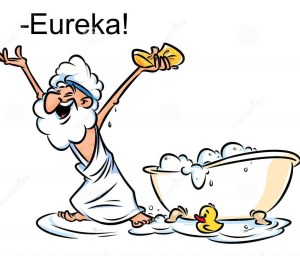
Some teachers are so busy concentrating on the skill or concept they had planned to “TEACH” that they lose sight of what else the children can learn during the experience. It may be hard to think of ducky-dumping as great science, but that is exactly what it is.  Ducky-dumping proves Archimedes’ Principle of fluid displacement – it is physics.  It is learning.

Spontaneous learning is also part of the Abe Vygotsky learning theory of “webbing” which is about creating new learning from “old”.  Webbing, or scaffolding, is one of the essences of REAL learning – moving from discovery to invention.  18 month old ducky-dumpers will dump over and over getting a clearer and clearer understanding of archimedesArchimedes’ Principle as they dump.  They do not know Archimedes (and who really did?) and they may never know his principle, but they will have experienced the actual use of the scientific process of exploration-discovery-experimentation-use-invention. 
Drop the mic! You are a teacher!

Next Blog: Components of Good Experiences

Experiences – Kinds of Learning

Before talking about the components, the production, and the appraisal of your learning experiences, we need to look at what kinds of learning happens in early childhood programs.duckie

Primary Learning – This is the learning that occurs when a child acquires the expected skill or grasps the expected concept listed as the goal, purpose, or intent of the planned experience.  Imagine toddlers playing with rubber ducks in the water table.  It is the intentional expectation that they will build fine motor skills, increase vocabulary, and maybe grasp the concept of ‘cold’ or ‘wet’.  The children practice manipulating the ducks with their hands and improve their eye-hand coordination.  They say ‘duckie’ or ‘quack’.  They put their wet hands on their faces, shiver, feel the sensation of cold, listen to the teacher say ‘cold’, repeat the word, and match it to the concept. Mission accomplished – this is Primary Learning.  It should be assessed and documented as a Strength Expectation met.

Secondary Learning – This happens when a child gains an unplanned skill or concept as a ‘byproduct’ of the intentional plan. During that same experience, the children may also squeeze the water from the ducks, spraying their friends’ faces, strengthening their hand muscles and laughing.  They have reached expectations in physical hand strength, social interaction, and humor that the teacher may not have primarily intended.  The children themselves have reached new expectations – this is Secondary Learning.   It should be recognized, assessed, and documented as a Strength Expectation met.

Spontaneous Learning, My Personal Favorite – This occurs when a child makes a brand new discovery while participating in an experience or applies the planned knowledge in an inventive, creative, and original way.  Again during the same experience, a child holds the duck under the water and lets it spring up, discovering the scientific principle of water displacement, and voila! – this is Spontaneous Learning.  

Next Blog: More About Spontaneous Learning!